Face Liveness Check & Voice Verification Systems for Secure Identity
As digital services continue to replace traditional in-person interactions, organizations need reliable ways to confirm that users are genuine. Passwords, PINs, and knowledge-based questions are increasingly vulnerable to phishing, credential theft, and social engineering. This has accelerated the adoption of biometric technologies such as Face Liveness Check and Voice Verification Systems, which provide stronger methods for establishing whether a person is authentic.
By combining facial and voice-based biometrics, businesses can create secure and convenient identity verification experiences while reducing the risks associated with fraudulent access.
What Is a Face Liveness Check?
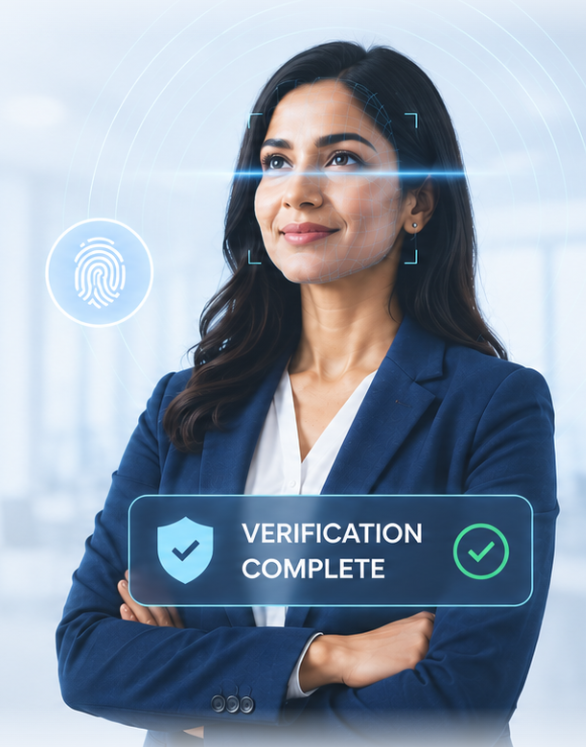
A Face Liveness Check is a biometric security process designed to determine whether the face presented to a camera belongs to a real, physically present person. Unlike basic facial recognition, which primarily compares facial features against an existing image, liveness detection focuses on identifying whether the presented biometric sample is genuine.
This distinction is important because fraudsters may attempt to bypass facial authentication using photographs, videos, digital displays, masks, or other presentation attacks.
Modern liveness technology can analyze facial characteristics and subtle signals captured through a device camera. Depending on the implementation, systems may assess facial movement, depth information, texture, lighting behavior, or other indicators associated with a live human presence.
Why Face Liveness Detection Matters
Facial verification can provide a convenient authentication experience, but facial matching alone may not always be sufficient. A system could potentially recognize that a submitted image resembles a registered individual without determining whether the individual is actually present.
A Face Liveness Check adds an important security layer by helping distinguish between a legitimate user and a manipulated biometric presentation.
It can be particularly useful for:
- Digital onboarding and customer verification
- KYC and identity verification
- Financial applications
- Account recovery
- Remote employee authentication
- Online access control
- Digital banking and fintech platforms
- High-value transaction verification
Organizations can therefore strengthen identity workflows without requiring users to visit a physical location.
Understanding Voice Verification Systems
Voice Verification Systems authenticate individuals using distinctive characteristics of their voice. Instead of relying only on what a person says, voice biometric technology can analyze characteristics associated with the speaker.
These characteristics can include aspects such as vocal patterns, pronunciation characteristics, rhythm, and other measurable properties of speech.
Voice verification can support authentication through mobile applications, contact centers, financial services, customer portals, and other environments where users interact through audio.
One major advantage is convenience. Users may be able to authenticate themselves without remembering another password or interacting with complex authentication screens.
Face and Voice Biometrics Working Together
Using facial and voice biometrics together can create a stronger multi-layered identity verification process. Each biometric modality provides a different source of evidence.
For example, a digital onboarding workflow could ask a customer to capture a facial video while completing a voice-based verification step. The system can evaluate whether the face appears genuine and whether the voice corresponds to the expected user.
This approach can make fraudulent impersonation more difficult because an attacker may need to overcome multiple independent biometric checks rather than a single authentication factor.
Applications Across Modern Businesses
The demand for biometric authentication is expanding across industries. Banks and fintech companies can use biometric verification to support secure account opening and transaction authentication. Healthcare organizations can use identity verification to help protect access to sensitive systems. Enterprises can integrate biometrics into workforce authentication and remote access workflows.
E-commerce and digital platforms can also benefit by using biometric checks during account recovery, high-risk activities, or customer onboarding.
The objective is not simply to make authentication more sophisticated. Effective biometric systems should also provide a smooth user experience while maintaining appropriate security and privacy controls.
Choosing the Right Biometric Technology
When implementing a Face Liveness Check or Voice Verification System, organizations should evaluate factors such as detection accuracy, presentation-attack resistance, integration capabilities, processing speed, scalability, and user experience.
It is also important to consider how biometric information is collected, processed, protected, and retained. Strong security practices and responsible data governance are essential when handling biometric information.
The Future of Biometric Authentication
Biometric identity verification is becoming an important component of modern digital security. Face Liveness Check technology helps establish the physical presence of a genuine user, while Voice Verification Systems provide another biometric signal for authentication.
Together, these technologies can help organizations build more resilient identity verification processes while reducing dependence on traditional passwords and vulnerable authentication methods.
As digital fraud techniques continue to evolve, combining multiple biometric signals with intelligent risk assessment can provide businesses with a more robust approach to protecting users, accounts, and digital transactions.

About Premium Author
This post has been authored and published by one of our premium contributors, who are experts in their fields. They bring high-quality, well-researched content that adds significant value to our platform.
You Might Also Like
Popular Categories
Stay Connected
Recent Posts







.png)